Merry Christmas 2025!

Christmas lights through the front door. Christmas Day, 2025.

“Oh my! I don’t usually have more than one, but it is the holidays….” [cue hysterical laughter]

Merry Christmas, y’all! I wish you all the meaning of the day. For the Catholics, and the similarly aligned, we look forward to the 12 Days of Christmas beginning today. To our fellow Christians, we celebrate fraternally, the incarnation of God, the Creator of the Universe. To the rest of America and those who choose to throw in with us, this represents a time vaguely associated with the Solstice that causes the Northern Hemisphere to contemplate the brightening of days, the eventual advent of spring, and a time where we think about love of our fellow humans, the idea we may achieve peace on Earth, and that individuals will find the emotional connection we all seek. (I’m sorry, Southern Hemisphere. I haven’t got anything for you on this one. The days will grow shorter. The warmth will fade away. And in your coldest times you will not have the bright spot of Christmas to look forward to. I’m feeling your pain.)

Our personal Christmas has been especially meaningful to me. My best friend in the choir, a bass like me, died 18 days ago. An ordained priest who left the clergy to pursue a ‘worldly life’, he never stopped being what priests aspire to be (if they are true priests): the lowly shepherds who gather the sheep who stray and return them to the fold. I suppose he never will be venerated, beatified, or sanctified, but he established a spiritual North Star for me, and his death so close to Christmas has rocked me emotionally and spiritually. That I say this day’s mass proved especially moving to me makes me think that the last time I felt this way occurred in 2019 exactly two months after my mother died (and I retired). It’s funny how we imbue meaning into the same annual ritual liturgy.

I approach my faith through music and musical ministry. Thus, the Midnight Mass this year meant I dwelt in the choir loft yet again despite thinking, “How much longer can I stay up until 2 or 3 a.m.?” I reference my comment to my recently departed friend from the bass section who last year at 84 found it a requirement to be in the loft on Christmas Eve, preparing for the first hour of the birth of Jesus. He could not stand for more than 10-15 minutes. He exerted himself to climb the steps to the top riser where the basses reside. Contrary to offering complaint, he climbed with a smile on his face. I kept thinking about him, about my slight musical retreat from participating in what my vocal gift allows me to do, and about how this night above most others enriches the spiritual experience for those who attend but Christmas and Easter.

We presented 45 minutes of music from a brass quintet (plus tympani), two organists using our CB Fisk Opus 147 pipe organ, and the two dozen voices of our choir. I invite you to follow that link to the page describing the organ. It inferentially mentions our cathedral space which remains one of the largest Roman Catholic cathedrals in America, providing space for about 2,000 worshippers.
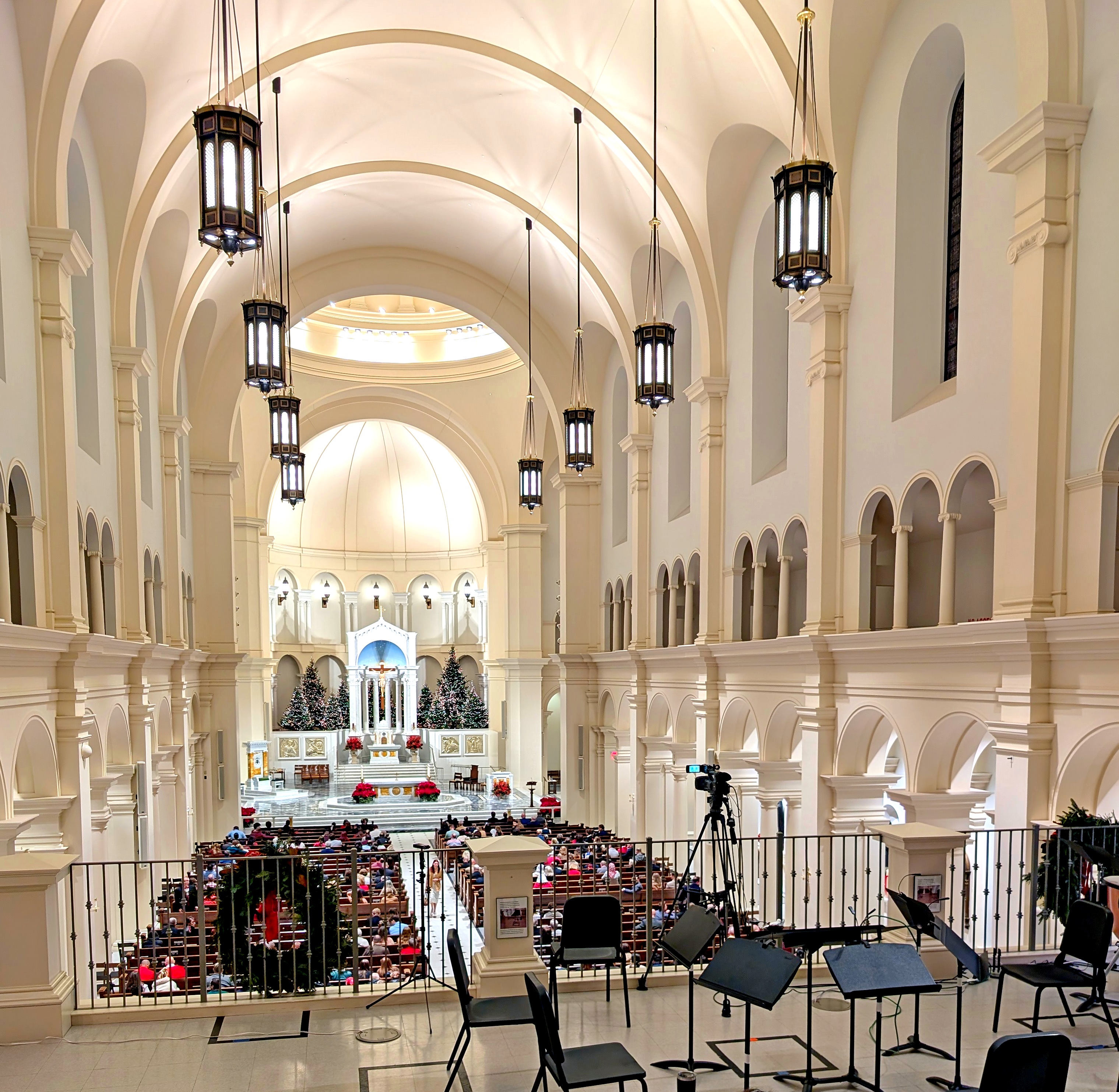
Holy Name of Jesus Cathedral, Raleigh, NC, preparing for Midnight Mass 2025. Two transepts exist to both sides of the altar area. The choir loft, foreground, shows the camera which will transmit a YouTube livestream, the seats and stands for the brass quintet, and is taken from the top riser where the basses sit. Christmas Day 2025.

Not unusually at Christmas, parishioners packed our cathedral.

Here’s a not-unusual detail for folks like me:

  • Spend Christmas Eve morning planning the logistics for the next 48 hours.
  • Align meal times with reality
  • Take a nap for 1-2 hours sometime during the 9 a.m. to 3 p.m. timeframe
  • Shower a second time…perform necessary personal grooming functions
  • Continue day to its normal concluding time (for seniors), but have dinner just a bit later
  • About the time one would prepare for bed, prepare to go to church instead
  • Get to church at 10:45 p.m.
  • Participate in pre-mass musical program from 11:15-midnight
  • Support the mass with musical ministray/leadership
  • When mass ends at 1:30 a.m., engage in social chat, drive home
  • Arriving home about 2 a.m. or later, and realizing you are far too jazzed to go to sleep, crack a bottle of “Christmas cheer” and calm in the alcoholic-existentialist manner until approximately 3:30 a.m.
  • Go to bed
  • Wake on Christmas Day about 8:30-9:00 a.m. Absolutely beat, and with no more than 6.5 hours’ sleep (usually more like 5.0), stumble through a few hours before saying, “Screw it, I’m having a beer, dear.”

There you have it: a raw, day-after download of what this (and many other) Christmas has meant to me. I wish you and yours the merriest of the day. Here on the east coast of the United States, about eight hours remain on Christmas Day. I hope however many you have (or had), they will be/were meaningful.
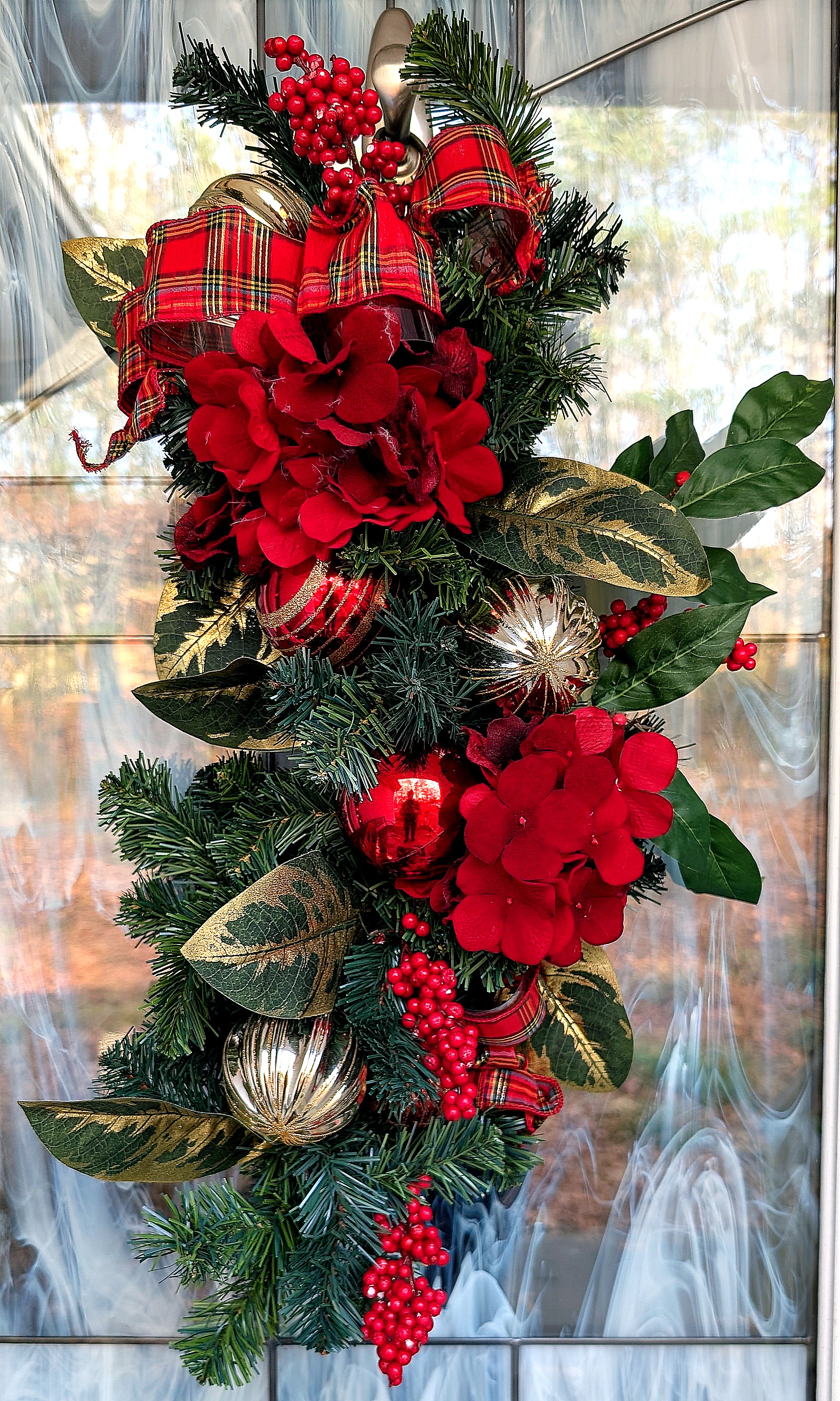
Door swag, Christmas 2025. Raleigh, NC.

three coins

perhaps a three-week hiatus demands a post about Three

Every morning after I’ve got pants and shoes on, I grab “stuff for my pockets” which varies depending on whether I anticipate going out and needing a wallet. Sometimes I don’t think I’ll need American coinage either, but I always grab a lip balm stick and three coins:

Top to bottom: Eisenhower dollar, Mary Queen of the Universe, and a guardian angel coin. Oblique angle, right, shows the etching better. December 2025.

This ritual, this grabbing of physical reminders, has existed from before the morning prayer time I started recently. Because I am who I am, I consider the smallest coin first. For a period of time when people held postal mail in higher regard than now, and the Internet hadn’t become the ubiquitous realm where we encounter one another, I received a regular marketing mailer from some religious publishing house. Or maybe it was a charity looking for donors. Regardless, every mailer had affixed to its mail-in card a cheap metal coin with an angel embossed on it. “This is your Guardian Angel! Take this gift as a token of our appreciation!” the card said. And one day when yet another of these things showed up, I did. I don’t pretend to understand the exact nature of a guardian angel, but I can say with certainty there have been many times when something bad should have happened to me or when I for some reason refrained from saying something incredibly stupid, and I think a higher power might have influenced things. The coin reminds me there are forces greater than me at play in the universe, and I would do well to give them a few seconds each day to stop and appreciate them.

I picked up the middle coin in February 2013 when we visited Kissimmee, FL, spur-of-the-moment. I had a suddenly empty work calendar in my new line as contract-professional-for-hire, and Florida promised to be warmer than Raleigh. In most ways that count, it remains one of the two best times I’ve had in my half dozen or so visits. Due to the sudden nature of it, I planned little. We just schlepped around and on our final day discovered The Basilica of the National Shrine of Mary, Queen of the Universe:

Interior, shrine to Mary, Queen of the Universe. Kissimmee, FL. February 2013.

Moved, I sought a small reminder of my experience there; hence the coin. In Roman Catholicism, the Marian tradition provides an important link for humans with God. As Mother of the Son of Man, God Incarnate, Mary becomes our symbolic mother just as Jesus is our brother. Thus our reverence for our mother, just as we revere our earthly mothers (hopefully). The coin reminds me of this link, of the powerful Family of God of which I am a wayward son, and of my brother-and-God, Jesus. Powerful stuff…and all in a few seconds!

My final coin (because it’s biggest) reminds of something far less religious, but no less meaningful. My father had an eclectic collection of coins he kept in a small metal box shaped and decorated as a 1940’s suitcase complete with travel stickers on it. He popped the occasional coin into it which he thought would be “worth something someday” or just out of curiosity. The U.S. Mint first struck an Eisenhower dollar in 1971 which likely explains why my father set this one aside. It also happened to be the first dollar coin minted since 1935. To me, however, it stands in for my father. I grab that coin and think about the oddity of putting 15-20 coins in a little kid’s bank and then doing nothing with it: he never took them out and looked at them, he never spoke about them, nothing. Only when he allowed my brother and me to dig around in his chest of drawers would we get to see what this little metal box held. In a larger sense, I see that profile of a bald president and think about my father in his final 20 years. I say a little prayer that he has found peace in the afterlife, a peace which eluded him here.
These few seconds…the little things we do which ground us.

Hold-outs

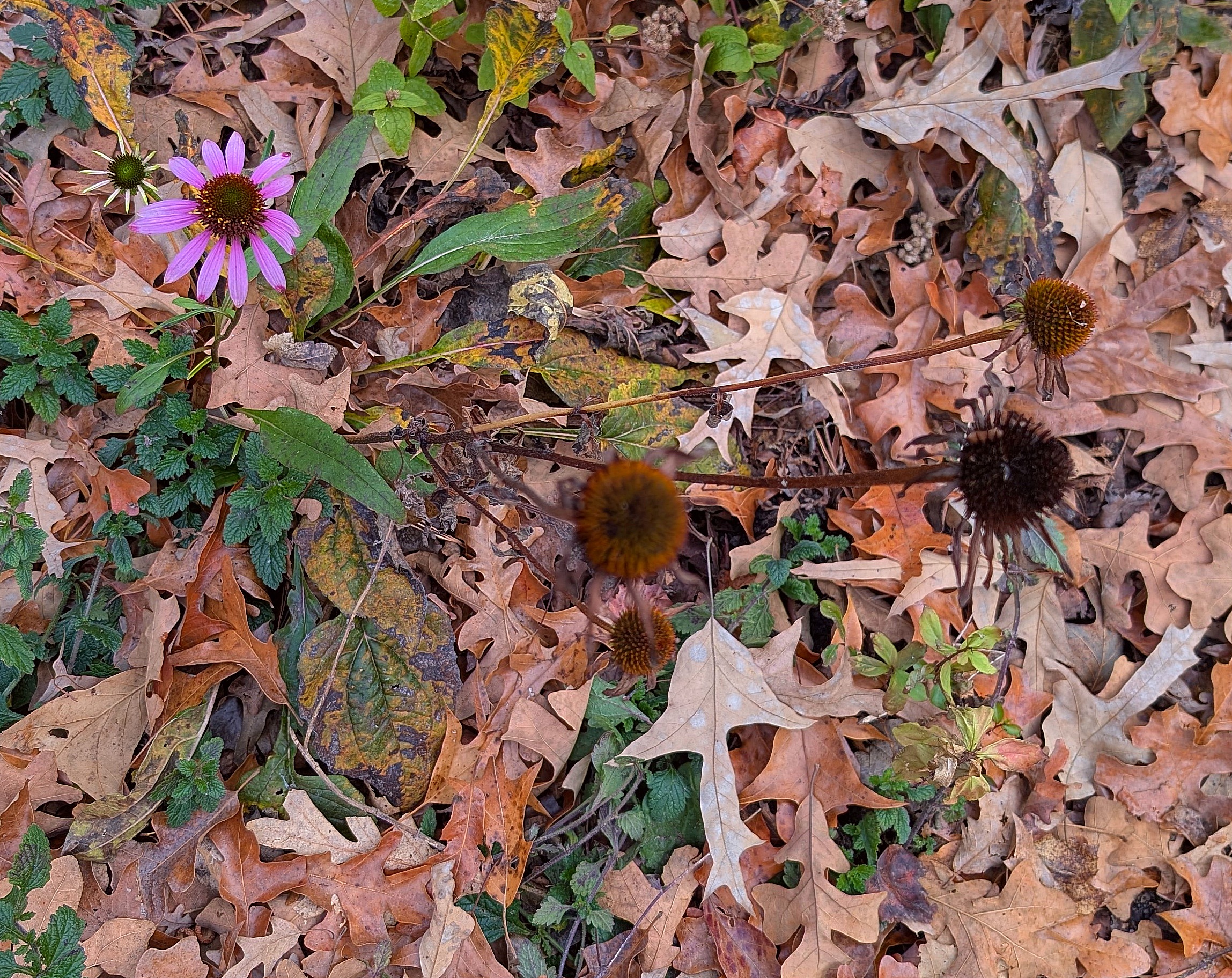
I seem to be on a leaf and garden kick. Though two short cold snaps have sent 99% of the plants into dormancy (unless they’re evergreen), a few brave stalwarts instead focus on the above-average warm weather to pop one last bloom out. November 3-9 ranged 65-75F with just a dash of rain the final two days. And then the 12th through 16th blessed us with sunny days of 64-73F. Look at these little troupers:

The blue mistflower who refused to die. All of its nearby compatriots are brown. Interestingly, the broad leaf or two at the top are from a purple coneflower, also still green. November 2025.
Another purple coneflower with living on its mind. All of the originals have gone to see on the right, but no matter. Let’s make more! A nascent bloom can be seen to its immediate left (the little white spiky one). November 2025.
Black-eyed Susan: you can see dead plant everywhere but it decided to come up again when the weather warranted. November 2025.

I keep falling for you

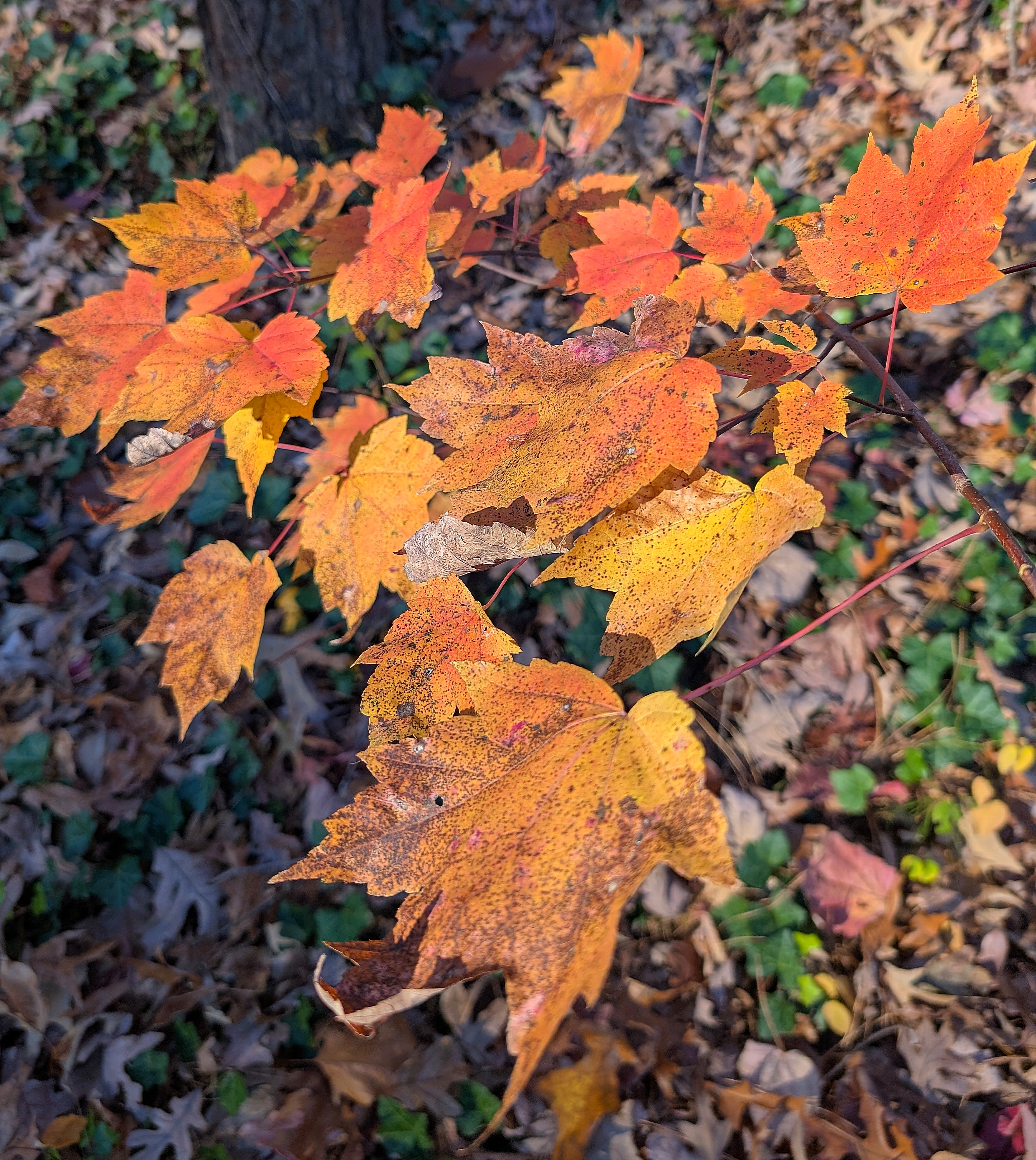
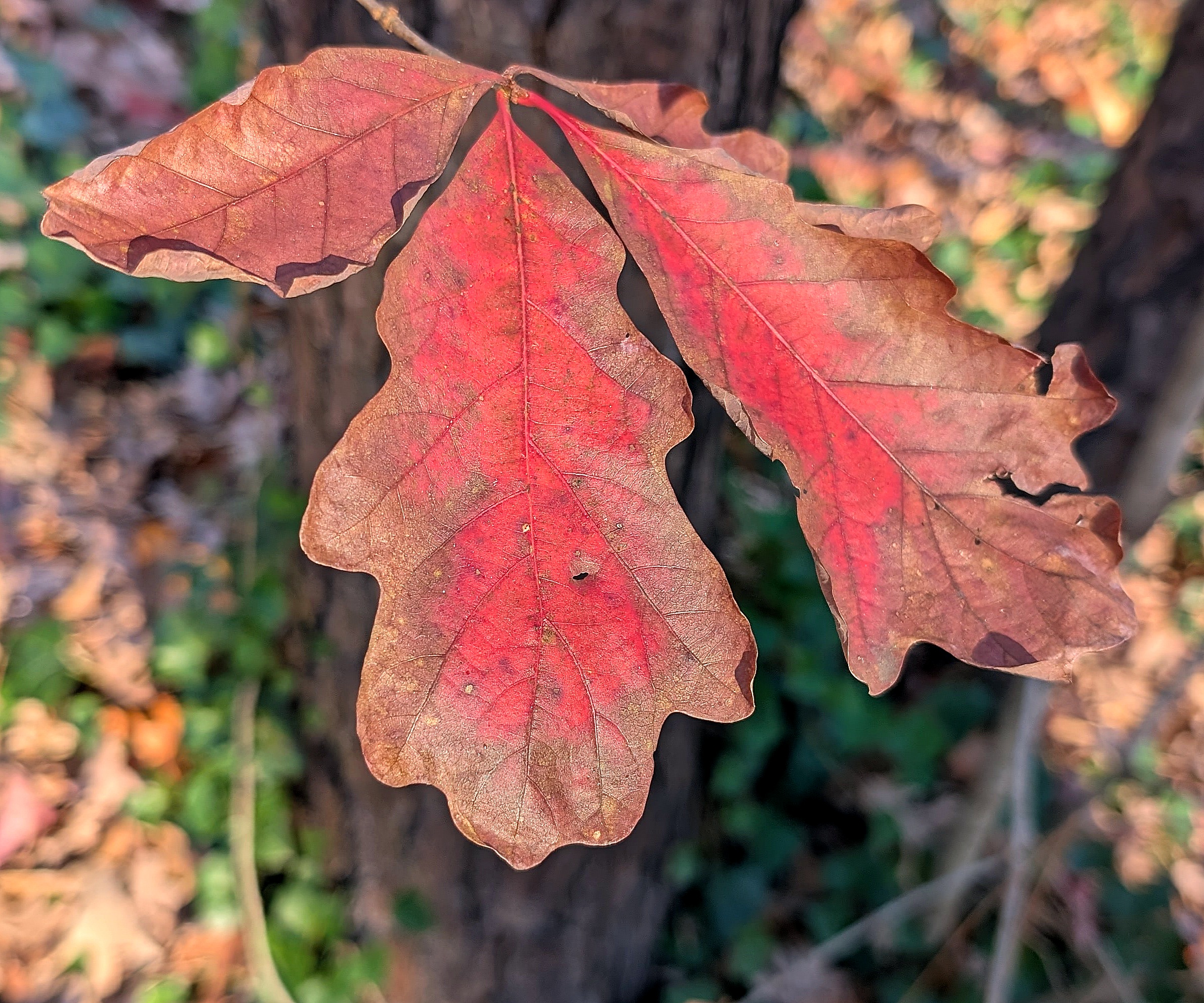
I took a walk this morning as the newly risen sun filtered through the tops of trees. The ethereal lighting isn’t quite captured here, sadly. Nice to see the natives doing well.

American beech, a.k.a., Carolina beech. November 2025.
Red maple. November 2025.
White oak…maybe…looks different than our white oak. November 2025.

Falling, indeed

Japanese maple, November 2024.

Unlike most years here in central North Carolina, temperatures have been colder than normal and our first hard frost occurred this morning. The above photo from November 24th last year, shows the glory of our lone non-native tree to survive The Culling, a.k.a., the landscaping project of 2024-25. This year it still retains red leaves but they are dulling. Dogwood, which in years past held onto their dusky maroon-colored leaves, now stand bare, attesting to the weather with a solitary leaf here and there. Plants closer to the ground now are yellowing and soon will follow the trees.

On the personal front, fall seems an apt term the past two years. At this time last year we were winning our battle against Covid, entering our third week in its grip. This year a Covid-like virus laid me low all of October 26th through November 2nd, and its nasty little cousin showed up yesterday, an intestinal thing. (“Detestinal” thing?)

Dry, sunny weather accompanies these low temperatures, providing a yin to the biting yang of it. Our bird world changes almost overnight: the year-rounders come back to the feeders to start bulking up, others disappear, and soon birds of prey will become more prominent on their leafless perches. Last week a raven lingered in front of the house, a surprising sight.

This year brought an unusual amount of treework in our near neighborhood. Trees and large limbs fell frequently during unusually rainy weather this summer. Fearful homeowners culled trees simply because they stood near the owners’ houses. A red oak ‘shared’ with our neighbor—it has managed to grow across the property line—dropped a limb the size of a small tree onto the neighbor’s driveway in a spot which had held a car until a week or two before the limb fell. Our good friends around the corner were not so lucky, losing a vehicle when a limb fell on a minivan about six weeks ago.

NC weather continues its wonderfully contrarian ways, at least to born, bred, and experienced Northerners (a.k.a. “Yankees!” as the Southern epithet is uttered). Temperatures promise to level out and this coming weekend will rise as high as 76. Any day after Halloween which promises temperatures in the 70’s (let alone the 60’s) seems to be a gift, even after living here nearly 20 years. And the most anticipated weather event for the coming months? The knowledge that someday in our near, winter-weary future, a singular weather pattern will convince a 70+ degree day to appear in late December or January. Always a welcome respite, even if its appearance always remains a cameo.

In milder years (2021), our trees still held green leaves on Nov 10th, let alone yellow. November 2021.

Bibliophilia: books about books

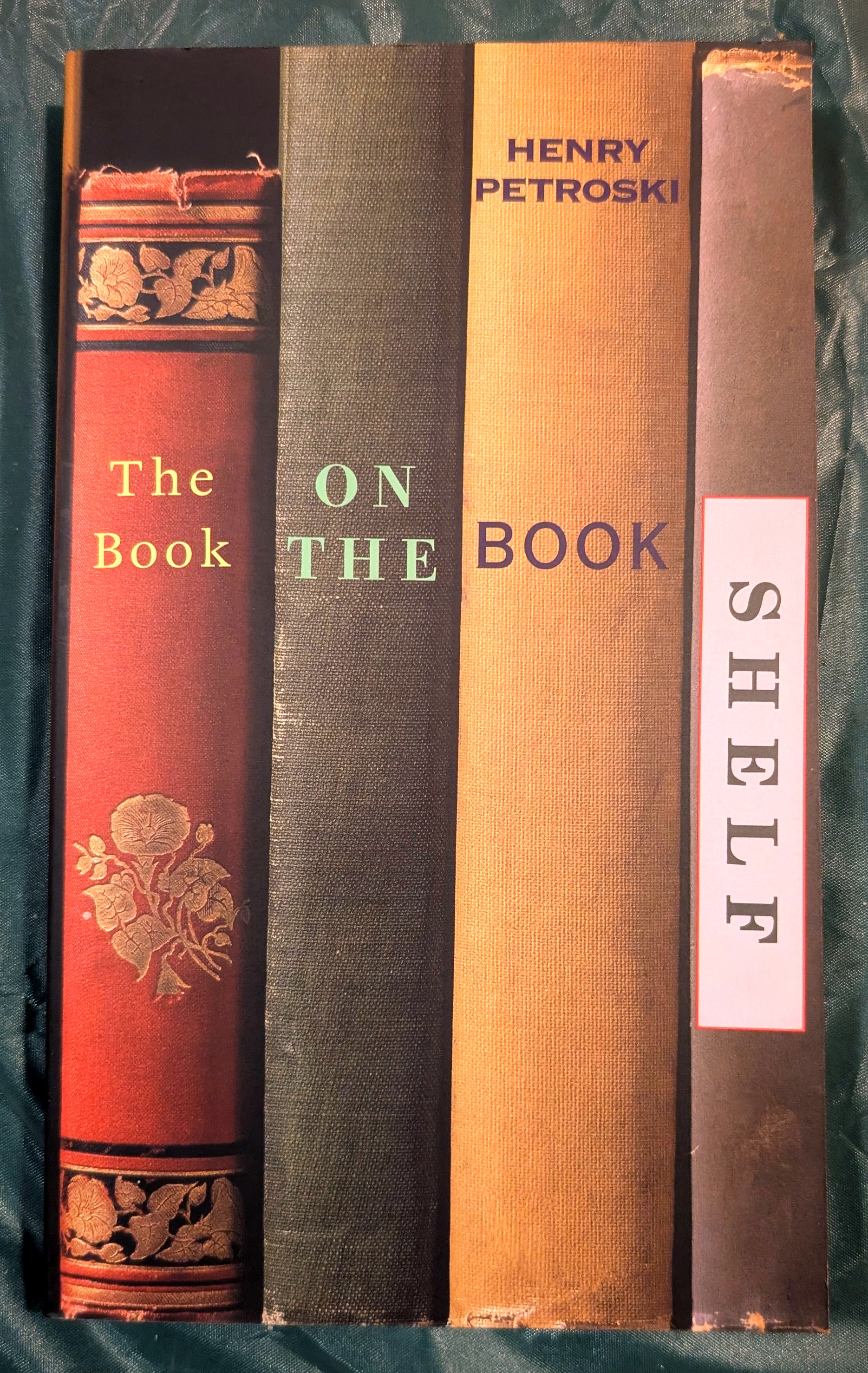
The cover to The Book On The Shelf

People who truly, truly love books, love books about books. One of the most unique of these appears above. Henry Petroski’s book The Book On The Bookshelf traces the history of books from their earliest inception as scrolls through the Middle Ages when they were chained to the shelf, and proceeds in its history to the present day. It’s a lovely read. Petroski winds up the book with a chapter about bookshops, another on the shelving of books, and a final one about the care of books.

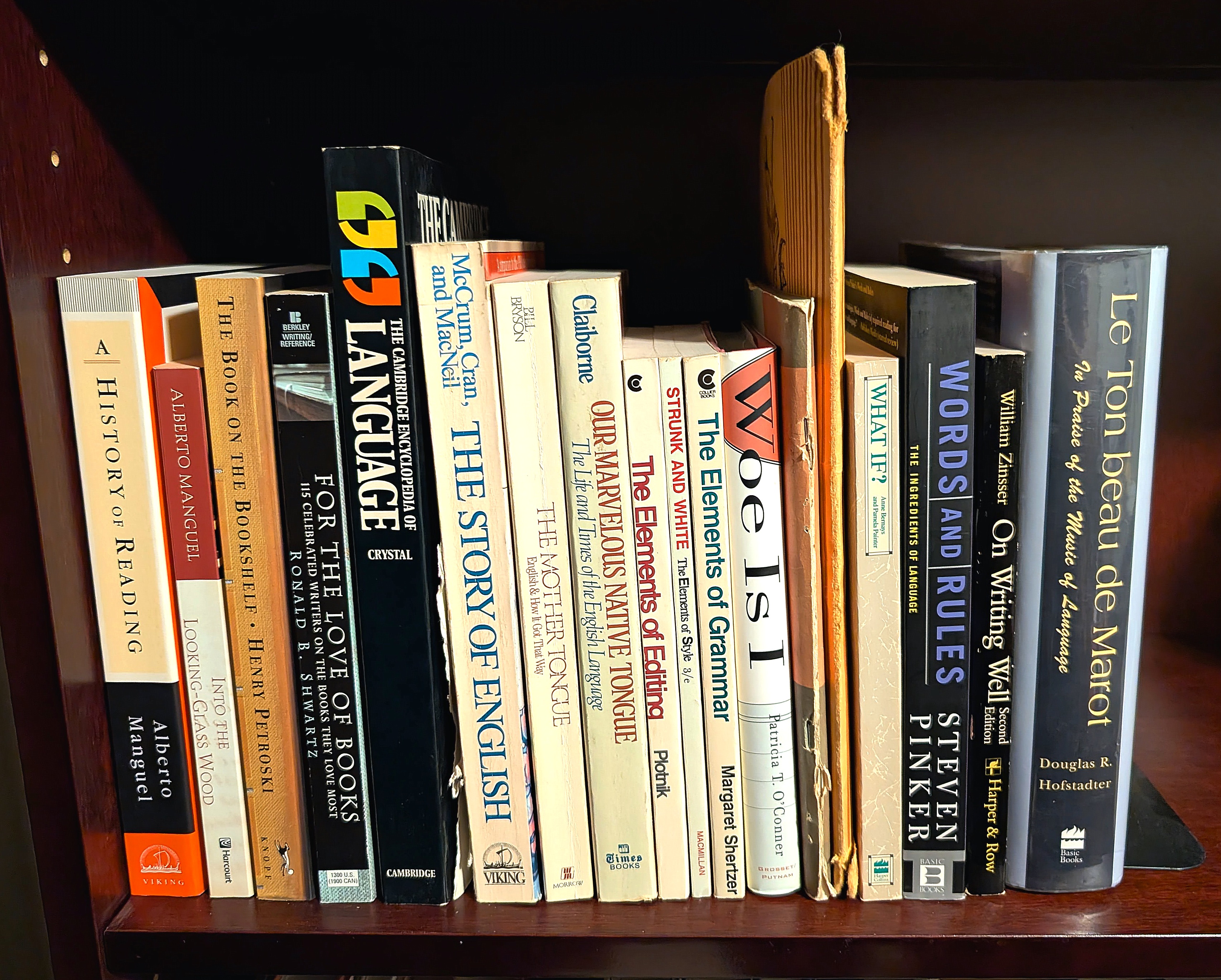
The phrase “books about books” includes those about reading them. My original photo for this Bibliophilia subplot is repeated here:

Books about books, language, grammar, and linguistics. July 2025.

In the semi-arbitrary manner I use to organize my bookshelves, books about books (and reading them) precede those which address English and languages. Alberto Manguel, an Argentine-Canadian writer (and translator, editor, essayist, and director of the National Library of Argentina) has two entries, both wonderful. A History of Reading celebrates the reader. With chapters such as “Being Read To” and “The Missing First Page” Manguel explores all of the aspects of the author-reader experience. Manguel divides the book into two sections: “Acts of Reading” and “Powers of the Reader”. I particularly liked this second section with its chapters of “The Author as Reader” and “The Book Fool”.

Manguel’s other book, Into The Looking-Glass Wood contains essays about books and reading. These range more widely than his History of Reading. Essays include reviews, reactions to other authors, browsing for books, essays about wordplay, and other more wide-ranging topics.

Ronald B. Shwartz’s book For The Love Of Books gets included here, simply because it’s on the shelf, and I can’t bear to part with it despite its shortcomings. I’m not one for the types of books which sample a range of acclaimed artists about a certain topic. This book gets the subtitle “115 Celebrated Writers On The Books They Love Most”. Yeah, so? What makes their opinion better or even equal to the critic for the New York Times Review of Books? Or any literature professor at dozens of highly regarded universities? Or, frankly, me? Regardless, I succumbed when I saw the authors cited include Joyce Carol Oates, Michael Ondaatje, John Irving, Bruce Jay Friedman, Doris Lessing, Norman Mailer, Witold Rybczynski, Kurt Vonnegut, John Updike, and Gay Talese. (Actually…I’m not sure I’ve ever completed this book! It still captures my imagination, and thus, it remains on my shelves.)

There you have it, books about books. If we can happily descend into the depths of books about books, how dare we deplore those who delve into the backgrounds of various oeuvres such as Tolkien’s Lord of the Rings? A nerd is a nerd is a nerd…

Bibliophilia: translation

Le Ton Beau de Marot, purchased in a shiny-covered form.

Having published a book review just an hour ago, it seems fitting to revisit my Bibliophilia series with what amounts to another review. Le Ton beau de Marot: In Praise of the Music of Language by Douglas R. Hofstadter impressed me to such an extent that I purchased another when I lost the book to a less-than-responsible work friend. For nearly a decade it bothered me that I couldn’t pick it up and show it to people when I said, “you’ve got to read this!” Finally, having purchased Hofstadter’s Pulitzer Prize-winning Gödel, Escher, Bach: an Eternal Golden Braid (which has proved so dense I’ve never finished it), I tracked down a used version of Marot from a bookstore in Santa Fe, NM. (I necessarily bought it used because it apparently was out of print.) It’s inching its way up the Read Me list, probably gaining the top position in 2026. But why gush about it? To answer that, I must detour to 1999.

In July 1999 my wife received news that the lump in her breast was a benign cyst, nothing to worry about. A little over a month later she received word that the tests had been mixed up and that she actually had cancer. This occurred on her birthday. After three surgery procedures in September, we took a vacation to the Oregon Coast just one week prior to her beginning the chemotherapy regime. We stayed in a wonderful condo on Yaquina Bay at Newport, OR. When we left, we took a leisurely drive up Highway 101 along the coast all the way to Astoria before turning east the next day toward home. Shortly before we arrived to Astoria we stopped at Seaside when a largish bookstore caught our eyes. There I found Hofstadter’s book. Loving language, I read the flap, learned it took up the challenge of translation, and that it also touched many other topics. From the flap:

…he not only did many of his own translations of Marot’s poem, but also enlisted friends, students, colleagues, family, noted poets and translators—even three state-of-the-art translation programs!—to try their hand at this subtle challenge.

The rich harvest is represented here by 88 wildly diverse variations on Marot’s little theme. Yet this barely scratches the surface of Le Ton beau de Marot, for small groups of these poems alternate with chapters that run all over the map of language and thought.

Not merely a set of translations of one poem, Le Ton beau de Marot is an autobiographical essay, a love letter to the French language, a series of musings on life, loss, and death, a sweet bouquet of stirring poetry—but most of all, it celebrates the limitless creativity fired by a passion for the music of words.

What the flap only hints at I learned later. During the time Hofstadter gathered his many translations by consulting all those people, his own wife was dying of cancer. Thus, his “musings on life, loss, and death” dive deep into his soul and therefore ours. Add to that my own wife’s tussle with cancer—she won, unlike Hofstadter’s wife—and the work compels. As I worked my way through the book, I found it dealt with language at a very basic level some of the time: how do we mean things? How does one language differ from another? How does cognition play out in word choices? And on, and on…

When I finished it, I felt Le Ton beau de Marot had been one of the best books I’d read because it didn’t just deal with language or cognition or love or translation or meaning or any other of those things mentioned above. It dealt with all of them! I loaned the book to a co-worker whose daughter was headed off to college to pursue a degree in English and who wanted to be a writer. I undoubtedly didn’t make it clear enough that one day I expected the book back. When I handed it off, though, I held back my gloss notes, which instead of writing into the book I had written out on fine paper. (They were too extensive to write into the margins anyway!) The book meant so much that I still have the notes a dozen or more years later. Here’s one:

[p. 138-139] I would side with Frost, that poetry is what’s lost in translation. Not that it can’t be re-discovered in the new language, but it’s not the same poem. Thus the poet-translator is intent on supplying a twin, not the real thing.

Hofstadter’s work combined with my college readings on communication, media, and meaning to form my personal philosophy and understanding of all types of translation. I “see” the issue of meaning more deeply than many I engage with when discussing how a work translates from one language to another, how people in different cultures perceive things, how books become movies and vice versa, even in how Superman or Batman is translated every decade by a different director all of whom seemingly work from the same “text”. I even see the problems of translation as one of the issues currently plaguing United States politics.

Hofstadter’s book satisfied on so many levels, engaged so many pleasure neurons, that I can’t do it any justice. You’ll simply have to read it yourself if you love reading about language and the problems of translation…and cognition…and…

Book review: Watering Words

Watering Words: 52 Short Stories by Bridgette Kay.
Self-published 2025. ISBN: 979-8-218-58862-5

Artists differ from most of the rest of humanity. Artists tap emotions and experiences others prefer to hide or, at best, to reveal carefully to select individuals and audiences. Unlike the careful revelation practiced by most, artists display their work on the public walls like graffiti in subways. Wedged between “For a good time, call ###” and obscenities, the artist inserts a portrait, often rooted in pain or struggle and rendered in words, brushstrokes, sculpted metal, or other media. Where most humans rush to clothe their naked feelings, the artist drops such obscurations to the ground and invites the errant passerby to look, but more than that, to judge. This is how they differ: they invite comment upon creations rooted in their own psyches, their own souls.

Humans hurt. We all hurt. We bear our wounds heroically, badly, simperingly, stoically, resentfully, and sometimes all of these and more depending on the time of day. Authors live with the uncomfortable knowledge that their wounds, their innermost thoughts, beliefs, prejudices, emotions, and most of all, memories, will bleed out—must bleed out—onto the pages they write, an emotional, psychic wound which perversely will not staunch without being exposed. It’s analogous to being handed a bite bar and hearing, “this is gonna hurt but you’ll thank me later.” Authors bleed out into their words and wait for the comments, but in truth, their healing began when the words gelled, the pages were printed, and the books displayed.

Commenting in any manner on such courageous behavior feels wrong. There cannot be a wrong way “to art.” As a teacher of English, though, I learned there exist many wrong ways to connect with an audience. And ultimately, anyone who publishes a book expects an audience to react to it. I’ve followed Kay’s blog Bridgette Tales for several years. Her personal revelations in that space represent why blogs need to be written. Done honestly and well, a blog sends joy and pain and struggle and hope out to the world, asking only to be heard. In the process, blogs show others, “Look! I hurt like you, love sunsets like you, see little clumps of moss like you, and I revel in it, even the painful stuff.” They build the global community. It came as a relief, then, when I discovered the stories were actually good. I’ve seen many a near-breathless author hand me something with excitement in their eyes and words, only to find upon reading it that the author hadn’t a clue either about constructing a story or writing one.

Don’t read Watering Words expecting John Cheever. These stories are not “high literature”—they instead represent what most readers look for: engaging stories with whimsy, a little magic, humor, and told with style. These stories speak less to the human condition than to one human’s condition. As one who has followed her blog, I see the pain, longing, fears, insecurities, joy, laughter, righteousness, sadness, glee, and maturity I’ve sensed in her near-daily posts. Two of the early stories stand out.

In the first story, “Waiting For The Bus”, every author will resonate with Kay’s personification of all those fears and excuses with which we keep ourselves from writing. The narrator’s ultimate triumph echoes Kay’s, I’m sure. And in “Final Goodbye” I invest my supposition that Kay writes of a home in her past (at least symbolically). I detect references to tragedies mentioned on her blog, but leave them for others to discover.

Read this book. Read it not for “high” literature but for “hi” literature: an author reaching out and saying, “Here I am. I’m saying it as best, as entertainingly as I can. Do you see me? Do you feel the same?

“Do your wounds match mine?”

Rüdesheim

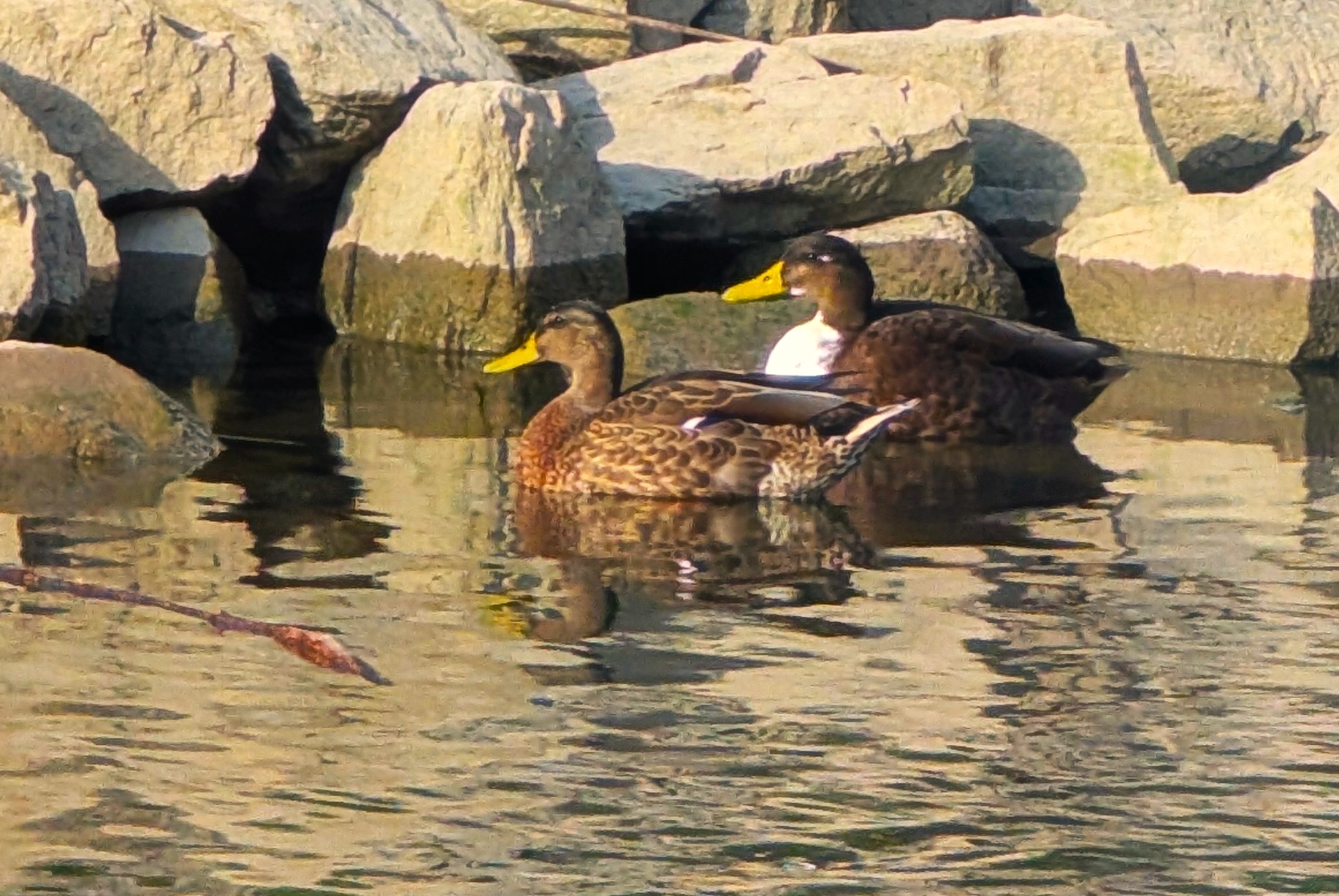
One of the several species of waterfowl we saw while moored at Rüdesheim, Germany. August 2025.

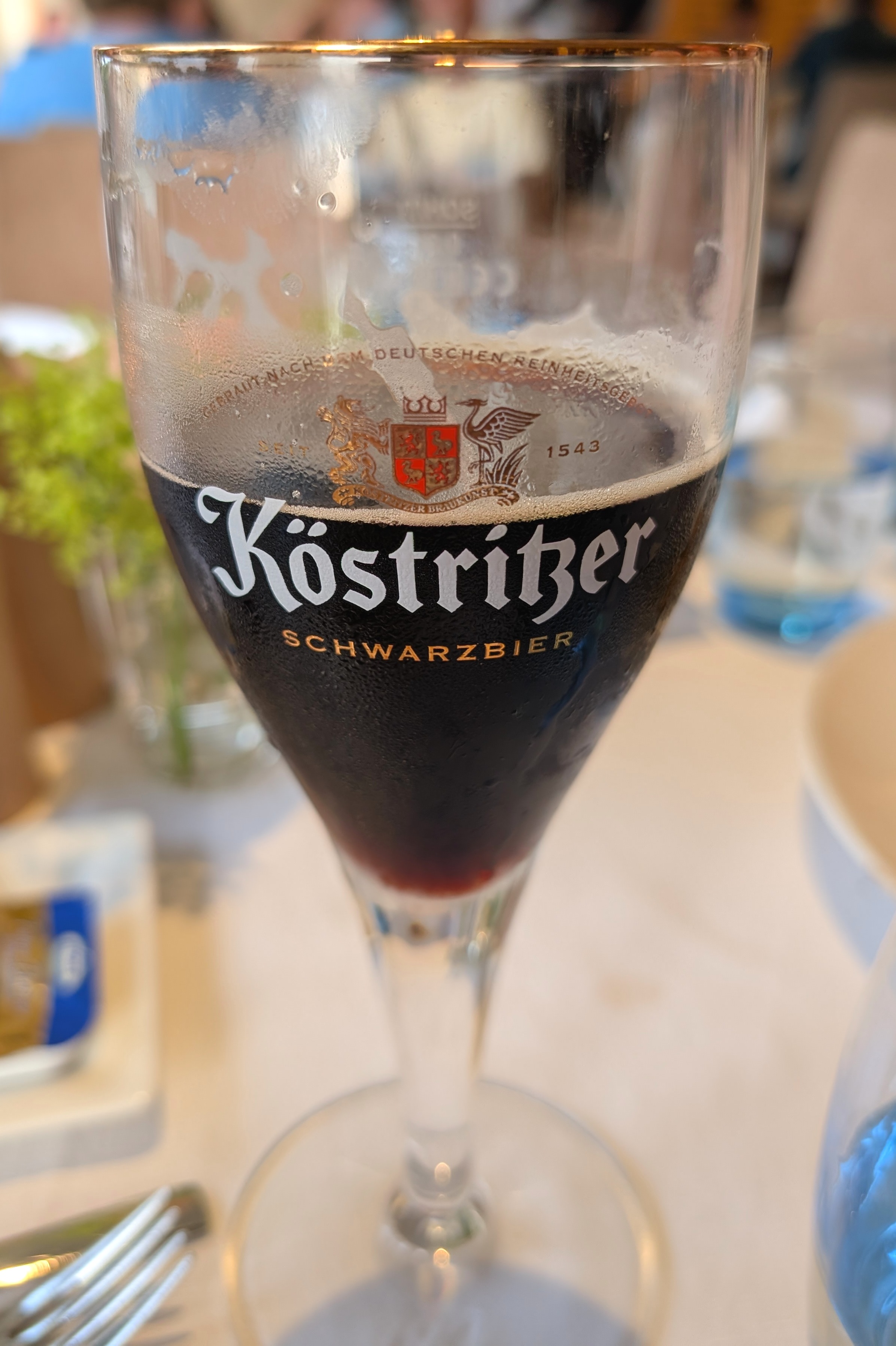
River cruising resembles train travel: you journey from Here to There but don’t have to do the driving yourself. One thus experiences the journey. (Flying lacks this: one experiences only the point of departure and the destination. The experience of travel disappears, lost in abstract non-motion at 30,000+ feet.) Our afternoon cruising capped our morning in Speyer, just right for my still-recovering wife. Once moored at Rüdesheim, we chatted with the local ducks and enjoyed fine beverages. For me, that included this delightful Schwarzbier from Köstritzer.

Speyer,…

…or Spires if you want the English name, presented a much-needed comfort level after the unanticipated end to our “Strasbourg Buildup” of expectations. Only 50,000 folks live in this city on the west bank of the Rhine. Yes, we now saw Germany on both sides of the Rhine. Midway through the night’s cruise to Speyer our ship had passed the point where the pentagonal border of France had turned to the northwest and left the Rhine behind. For the first time since Basel, we docked on the west bank of the river. We had the worst guide of the trip there, but a lovely time nonetheless—we simply ignored him and tried to stay within shouting distance of the group. (“Worst guide ever” equates to having him leave a third of our group at a crosswalk where the light had turned against us. He continued with the tour, and then admonished us when we saw a break in the traffic, crossed against the light, and ran to keep up with his idea of pacing a tour!)

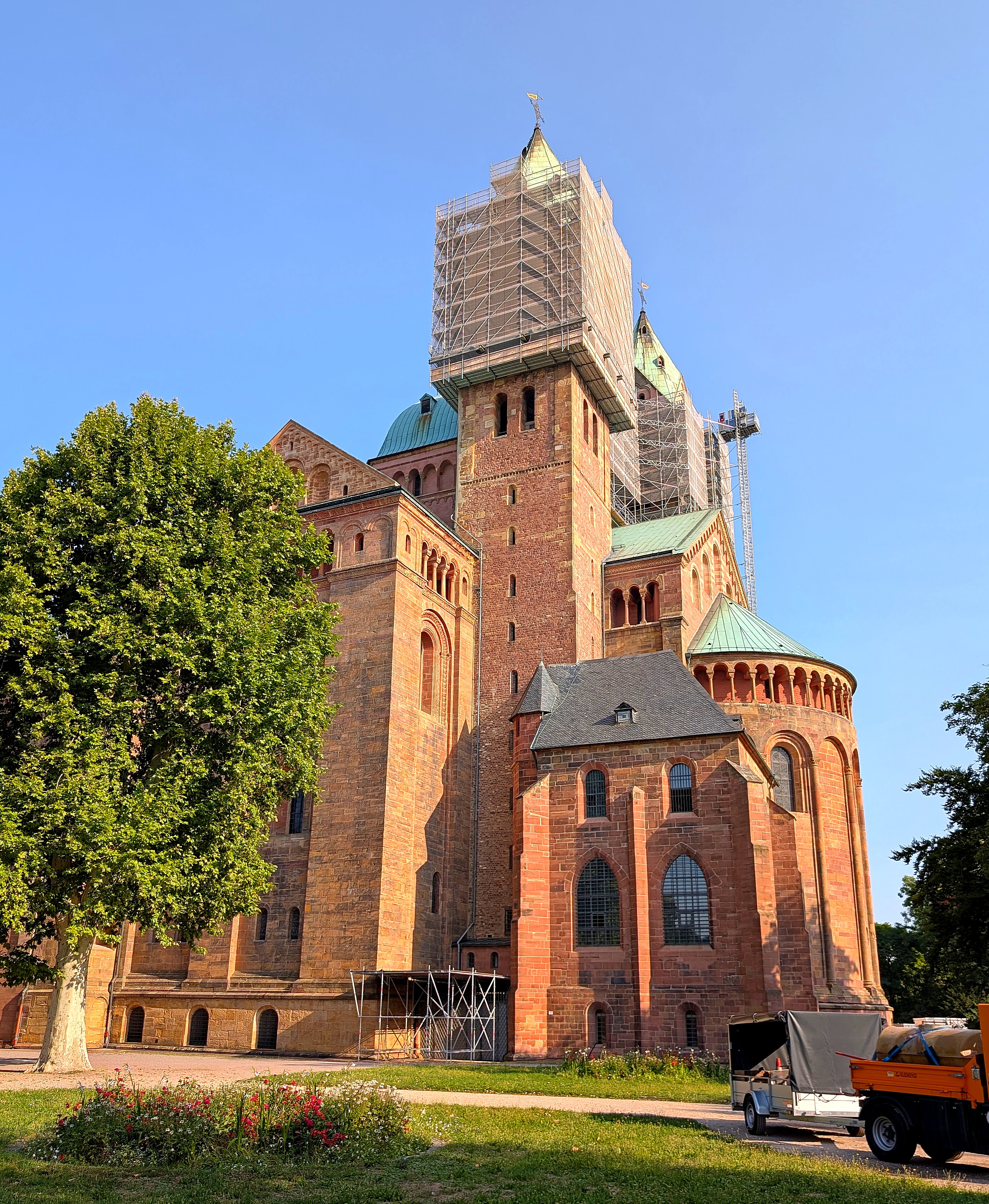
Speyer’s cathedral dominated the city both in its placement on the edge of the bluff overlooking the river, and simply because its size completely outstripped any other building around it. I need two photographs to show all of it:

Speyer Cathedral, east end, with extensive renovations occurring. August 2025.
Speyer Cathedral, west end. I normally avoid wide-angle shots on buildings like this, but it proved necessary. The abutment on the right edge is visible in the previous photo behind the tree on the left. August 2025.

Parishioners built the cathedral in several distinct phases. Though our guide dryly and boringly explained it to us, I concentrated on photographs to his exclusion. I therefore can’t give you much history about the building’s timeline. I do remember that like all “touristy” cathedrals you will ever see, this one was the biggest in some category or other—I think “biggest at the time it was built.” If I remember correctly, the middle part of the building (seen in the second photograph) predated either end. Part of it had to be rebuilt after WWII, also. Look on the tower in the second photograph and you’ll see stones laid much more hodge-podge on the lower right of it. The rest gets a more uniform, geometric treatment.

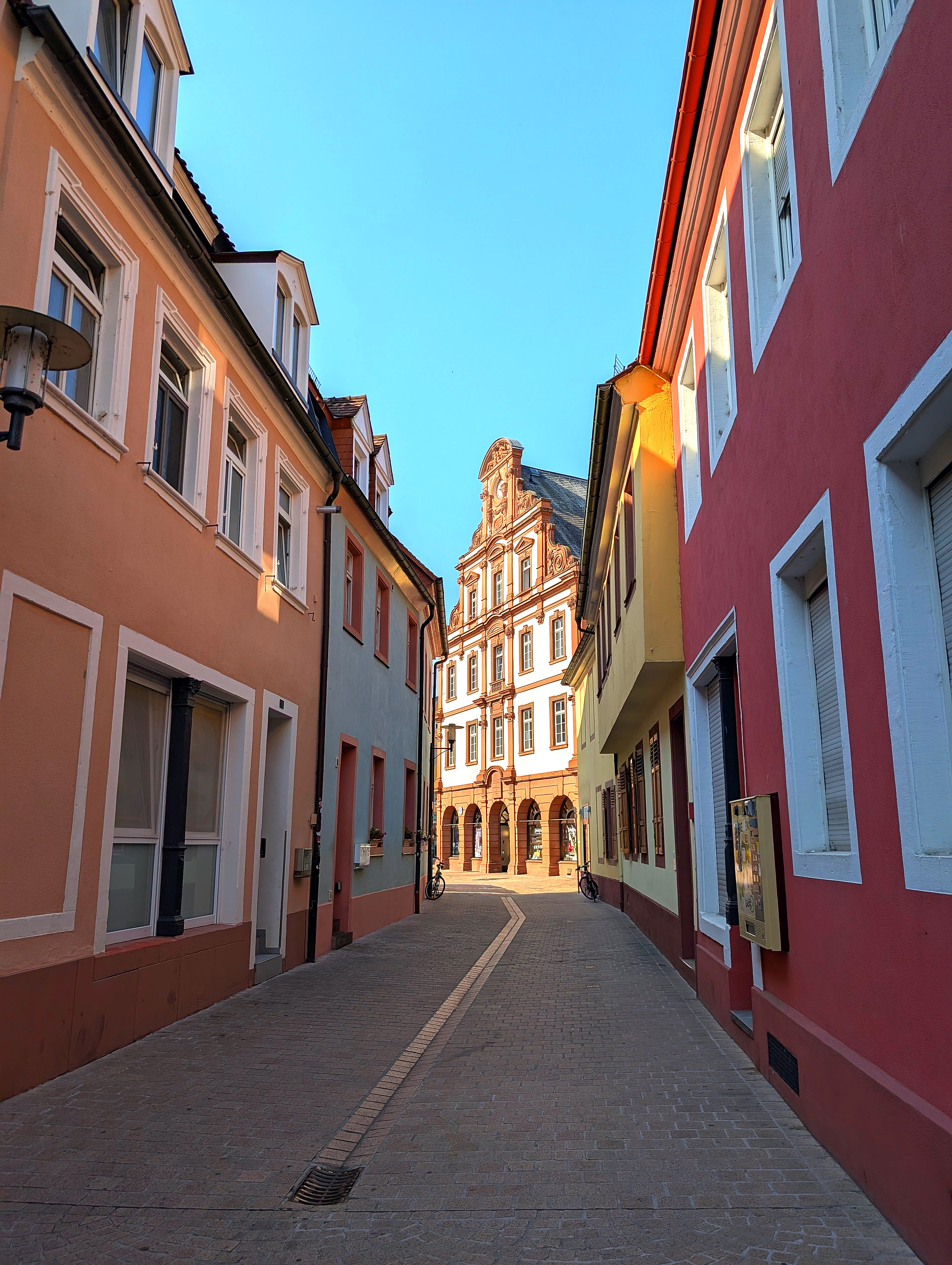
Our guide left us no time to go inside the church. Instead, he took us into the center of the city, a small area of just a few blocks which extend westward from the church. As we turned westward from the cathedral, he noted (for our safety) an oddity I’ve not seen anywhere but Speyer: a city street routed through the plaza, marked only by regularly spaced concrete posts. It struck me simultaneously as beautifully quaint and dangerous.

Speyer cathedral throws a shadow on the historical building across the plaza from it. In the foreground runs a city street, marked by the posts visible in front of the building. I don’t remember if the lighter paving stones represent ‘sidewalk’ or not, but I think ‘not’ is the operative word. I believe the building pictured served at one time as quarters for the bishop, but now might be a private residence. Speyer, Germany, August 2025.

Our guided trip into town proved blessedly short, after which we broke free and wandered at will. We quickly encountered a beautiful Orthodox church…I think.

As far as we could get into this beautiful sanctuary—a locked glass door prevented entry but facilitated photography. Speyer, Germany, August 2025.

We struck off from the main street through the city center and found little plazas tucked behind several other buildings. One hid a strikingly designed school of drama, if I read the German correctly. The streets off of the main drag lived up to my fantasies of narrow, old, and quaint. A sign informed us that many of these buildings were associated with the Jewish community. Speyer and the nearby cities of Worms and Mainz have been recognized as UNESCO World Heritage Sites. Near the photo on the right (below) we passed an old synagogue.

Yes, they allow cars down this street. Note center-of-street gutter. Speyer, Germany, August 2025.
It’s true, all streets curved to the left! (Unless you turn around.) Speyer, Germany, August 2020.

Walking back toward the cathedral to meet up with our group for the walk back to our buses, we finally had time to enter the cathedral. We made a good decision to allow time for that.

Much older than other churches we encountered on our trip, Speyer’s looks much smaller in this photo than it is. This is due to the large supporting columns which frame this shot. Speyer Cathedral, August 2025.

Speyer’s cathedral offered a delightful blend of modern furnishings contrasting with the centuries old structure. The minimalist lines of its furnishings complement the austerity of the stonework. It had several altars. I surmised different ones get used depending on the size of the congregation at that particular service. Perhaps at least one stands there for historical reasons. The most modern one sits far forward. The candles flanking it, both those on stands and the votives to the side, were displayed on modern metalwork which evoke the baroque in a minimalist way. The bishop’s chair sat halfway back in the sanctuary (altar area), to the right in the photo below. The next photo gives a sense of the depth of the sanctuary/chancel.

The first altar of the Speyer Cathedral. Note the organ in background. Speyer Cathedral, August 2025.
Bishop’s chair and back portion of the sanctuary. Speyer Cathedral, August 2025.
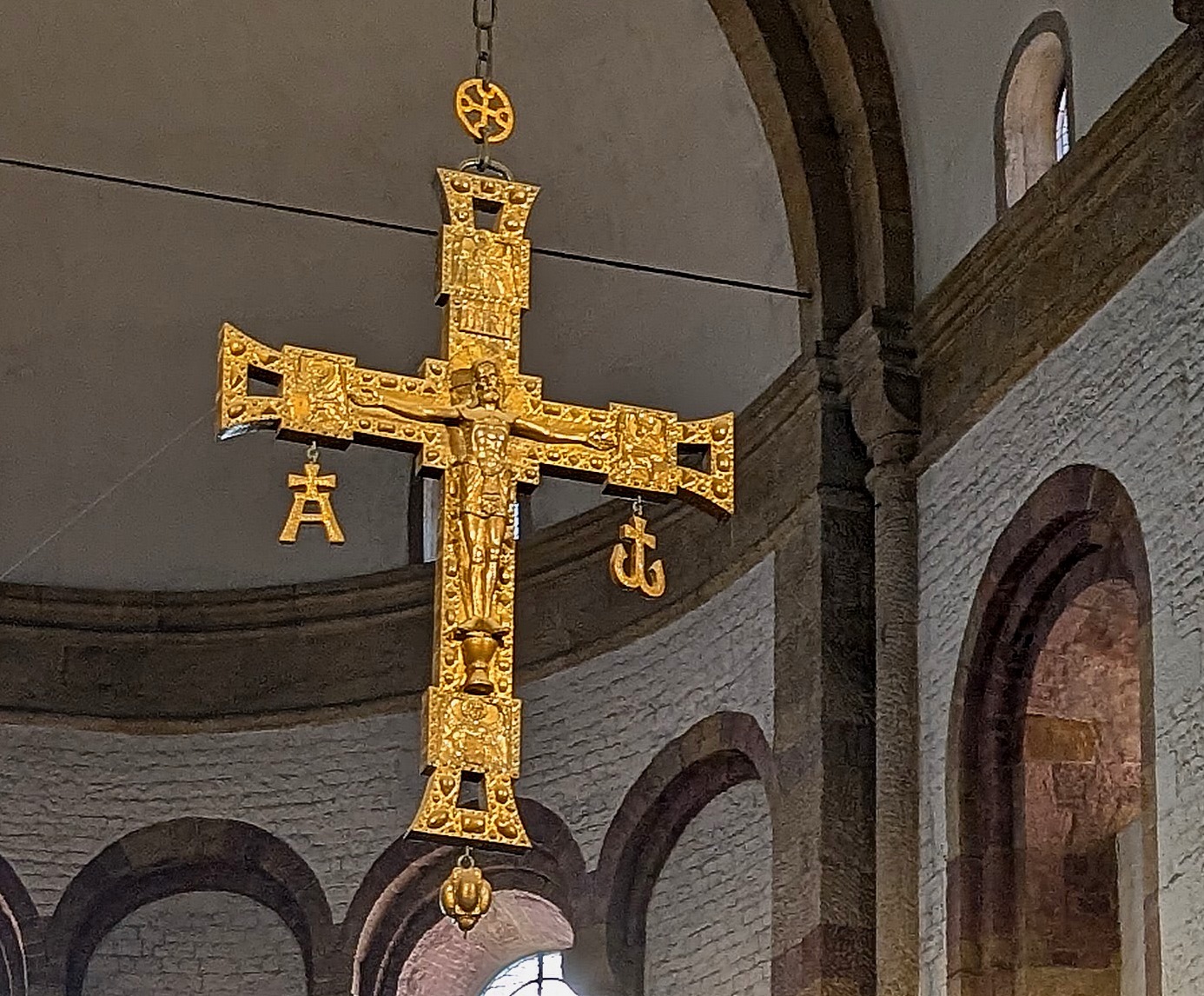
Detail of the suspended cross just rear of the “bishop’s altar” in the middle of the chancel. August 2025.

When looking at the photo above, you’ll remember the bishop’s chair is to the right of the first altar. In the lower right corner, note the raised floor. This is for the second altar. Light shone into the cathedral from many angles. At the top of the photo is the lowest tip of a suspended cross, caught in sunlight which casts a shadow on the back wall. See detail, left.

Our several tour groups boarded buses for a short trip to Worms where the good ship Hlin had tied up after getting a head start on the afternoon voyage to Rüdesheim. We couldn’t seem to take enough photos as the historical buildings glided past us. That evening we stayed aboard. Others had purchased one of two different dinner packages (one at a fort high atop an overlooking bluff).

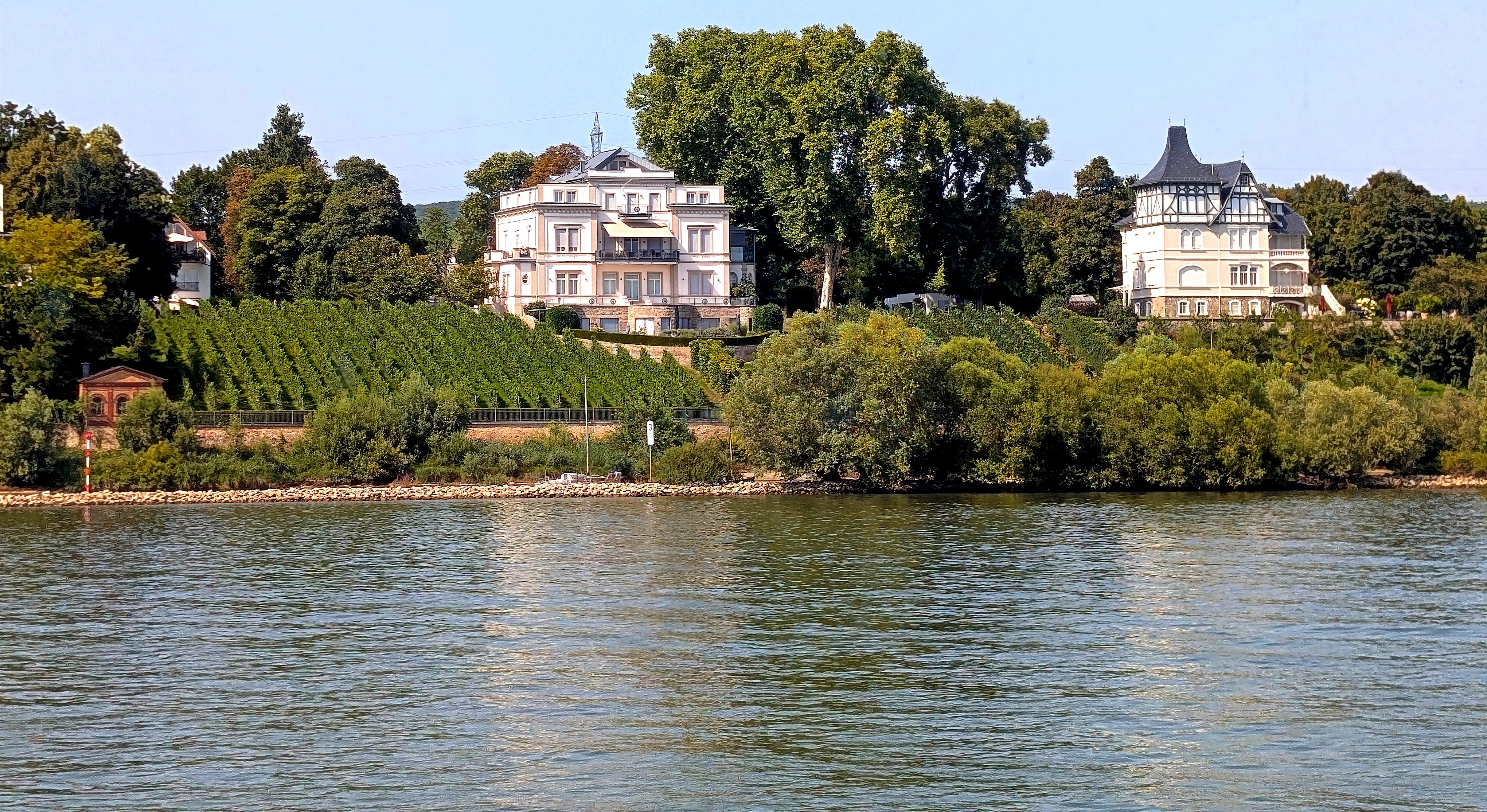
From the starboard side, first you photograph the building on the right. Then you see the next one to the left…then its vineyards…then the little red stone building down by the railroad tracks which run along the Rhine. Then there’s another building…it never ends. And you’re sitting in the lounge where the next cool beverage is only steps away. August 2025.